Discover the Essential Factors That Affect Your Search for “Restoration Costs”
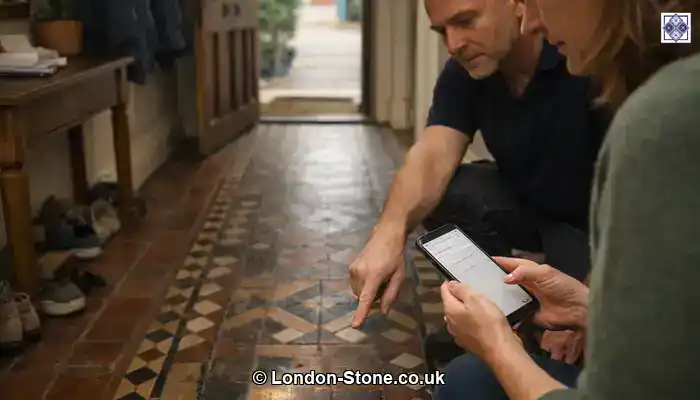
The cost of Victorian tile restoration is a multifaceted topic that can often confuse homeowners. This comprehensive guide delves into the financial elements associated with restoring Victorian clay and encaustic tiles, offering a thorough budgeting framework for homeowners. While the technical aspects of heritage tile care remain consistent across the UK, the pricing can vary significantly due to local labour rates and logistical considerations unique to different regions.
To ensure the most precise benchmarks, the figures presented in this guide are based on the day rates of specialists and typical project scopes within London and its neighbouring Home Counties, such as Bedfordshire, Berkshire, Buckinghamshire, Essex, and Hertfordshire. These areas are renowned for their dedication to preserving heritage tiles. Whether you are looking for a cost-effective solution or seeking to hire the right specialist, this guide clarifies the vital factors that influence pricing and outlines strategies to sidestep the hidden costs often associated with repeated restoration efforts.
If you have entered the phrase “Victorian tile restoration cost” into Google, it is probable that your search goes beyond merely finding the lowest price. You are likely eager to comprehend what the restoration process entails, which factors may contribute to increased costs, and how to avoid incur the same service more than once.
Gain a Comprehensive Understanding of Restoration Costs for 2026 in London and Surrounding Regions

- Specialist Day Rate: £250–£650 (Factors include location, access, and specific expertise).
- Small Hallway (≤15 m²), Clean + Seal: £500–£1,300 (Typically a 2-day project).
- Significant Repairs: Often add £350–£650 (usually require an additional day).
- Subfloor Remediation: Major structural works can exceed £5,000 for full stabilization.
The decision to restore your tiles is rarely as straightforward as simply asking, “Should I clean the floor or not?” The factors that influence this decision are often much more intricate:
- Is the task a straightforward clean and seal, or does it involve hidden complications lurking beneath old coatings and adhesives?
- Is the present condition of the floor stable enough for restoration, or are prior repairs necessary to ensure both safety and effectiveness?
- Can I obtain a useful ballpark estimate based solely on photographs, and when would it be imperative to arrange an on-site visit or create a test area?
- How can I effectively compare various quotes without making assumptions about what each one entails?
This guide aims to equip you with essential knowledge regarding how specialists determine their pricing for old clay tiles in London, Bedfordshire, Berkshire, Buckinghamshire, Essex, and Hertfordshire by identifying genuine scope drivers and establishing realistic limits.
Why Are Victorian Clay and Encaustic Tiles Priced Differently from Modern Flooring Options?
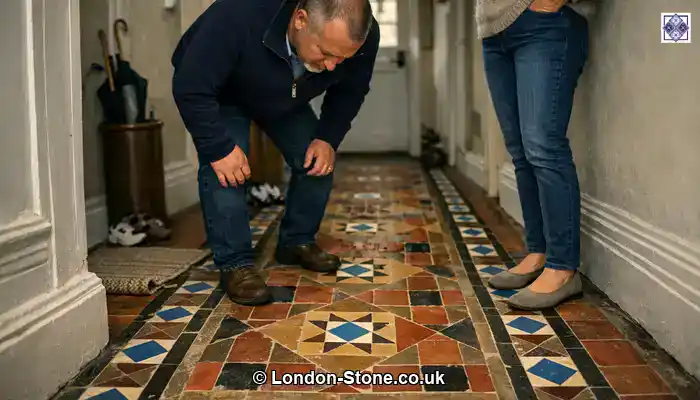
Victorian and encaustic tiles represent a distinct category compared to modern glazed ceramics. These historic tiles are generally unglazed, porous clay that incorporate oxide pigments, with many originally installed without a contemporary damp-proof membrane (DPM). This fundamental difference profoundly impacts the methods employed for cleaning, drying, and sealing.
From a pricing perspective, two crucial elements must be taken into account:
- What’s embedded in the pores and on the surface (including old waxes, degraded films, adhesive staining, and ingrained soil).
- What’s occurring beneath the surface (assessing whether the floor is moisture-active, determining if the tiles are loose, and evaluating if the joints or the bed are compromised).
This explains why a Victorian floor may initially appear “simple” on the first day, only to develop into a more extensive job as the old coatings begin to peel away, exposing the true condition of the tiles and joints beneath.
What Should You Expect from a Typical Restoration Process: Cleaning, Minor Repairs, and Sealing?
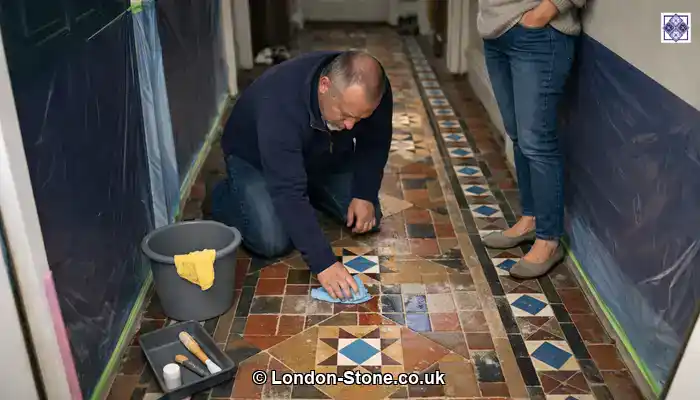
Establishing a solid baseline is essential because much of the confusion surrounding costs arises from comparing a basic clean-and-seal quote with one that discreetly encompasses stripping, adhesive work, or necessary stabilization.
A typical baseline scope (assuming the floor is generally sound) usually includes:
- Setup and protective measures to safeguard the surrounding areas.
- Deep cleaning specifically tailored for porous clay tiles, employing controlled rinsing and extraction techniques to avoid over-wetting the subfloor.
- Minor repairs executed during the cleaning process (including small local fills, stabilisation, and touch-ups on the joints).
- Sealing generally requires 2–4 coats, with approximately 30–60 minutes drying time between coats, contingent on environmental conditions and the specific sealant used.
This baseline does not include extensive stripping of heavy coatings, removal of stubborn adhesive residue, widespread joint replacement, tile replacement, or subfloor remediation. These represent separate scope drivers that can considerably elevate costs.
Breaking Down Typical Costs for Small Hallways: Key Assumptions and Influencing Factors
Many Victorian tile restoration projects take place in terraced hallways, which are often compact and challenging spaces where a single worker can operate efficiently while two may struggle to navigate. For these types of jobs, specialists frequently charge based on a day rate, as the work can block out other appointments.
Day-rate range used in this guide: £250–£650 per day. The position within this range is typically influenced by logistical factors such as parking and access, which can be more complex in certain areas of London while being more straightforward in some parts of Bedfordshire, Berkshire, Buckinghamshire, Essex, and Hertfordshire.
| Scope | Typical Days | Typical Range | What Must Be True For That Range |
|---|---|---|---|
| Small hallway (≤15 m²): clean + seal (baseline) | 2 days | £500–£1,300 | Clean + seal only; no heavy layered coatings; no major adhesive/gripper work; no instability needing major repairs |
| Significant repairs on a small hallway | +1 day (often) | +£350–£650 | Repairs move beyond “minor”; grout work, tile repairs/replacement, or stabilisation are required. |
| Subfloor failure / major works | Variable | Can exceed £5,000 | Evidence of lifting, dusting subfloor, or widespread movement requiring structural remediation, not just cleaning and sealing |
Typical small hallway baseline: up to ~15 m², planned as 2 days:
- Day 1: setup, deep cleaning, and minor repairs where feasible.
- Day 2: sealing, typically requiring 2–4 coats with 30–60 minutes between coats.
Using the approved day-rate range, this baseline typically falls within £500–£1,300 for a small hallway.
The key consideration is the assumption. That range applies only when the job is genuinely “clean, minor repairs, then seal.” If thick coatings, gripper adhesive, salts, loose tiles, or failing joints are present, the duration (and therefore cost) can increase significantly.
Understanding the Key Factors That Lead to Increased Costs: Old Sealers and Multiple Coating Layers
One of the primary reasons for an increase in the cost of restoring Victorian tiles is the presence of old sealers. Many homeowners mistakenly perceive the issue as a “dirty floor,” when in reality, it is often caused by multiple layers of failed coatings that trap soil and deteriorate unevenly.
When several layers of old sealer are present, the removal process can necessitate:
- Multiple applications of sealer remover.
- Repeated agitation and extraction cycles.
- Hand detailing around edges and intricate patterns.
In extreme cases, the coating can be so thick that it requires hand scraping for removal. Smaller tiles and worn, dished surfaces can complicate this process, as residue tends to settle in low spots and along edges. At the same time, aggressive abrasion is not a suitable method for expediting the process on heritage clay tiles.
As an example (though not a guarantee), there have been instances where a ~15 m² hallway required approximately 2 days to strip the old sealer and clean the underlying tiles, which included about 1.5 days of careful hand scraping due to the thickness of the coating and the dished nature of the tiles.
This pricing implication indicates that heavy coating removal can add 1–2 days to the project duration, depending on the thickness and number of layers. It cannot always be confirmed from photographs alone.
Identifying Hidden Labour Costs Associated with Carpet Gripper and Adhesive Residue in Restoration Estimates
Carpet gripper presents a common unforeseen challenge in Victorian hallways. This issue extends beyond the timber strip itself; it also includes the underlying materials and the potential risks involved in its removal.
How Can You Effectively Remove Glue-Down Gripper?
Removing a glue-down gripper necessitates careful extraction of the wood without displacing the tiles. Once the timber is removed, the adhesive residue often requires:
- A controlled application of adhesive remover.
- Appropriate dwell time for the remover to take effect.
- Hand scraping followed by pad scrubbing.
- Multiple applications if the residue is particularly thick or has penetrated deeply.
This process is slow and labour-intensive, often consuming a full day due to the need to wait for dwell cycles and safely lift the residue.
What Should You Consider When Dealing with Nailed or Screwed Gripper?
Removing a nailed or screwed gripper calls for extreme caution to minimise potential damage to the tiles. In practice, the removal of fixings often results in some level of damage, necessitating the filling of the resulting holes with a colour-matched filler, such as cement, hard wax, or resin.
While this filling can be blended to some extent, complete invisibility on worn historic tiles cannot be guaranteed. Nevertheless, it often represents a practical compromise to stabilise and tidy a floor without escalating the job into a full uplift.
Recognising Repairs That Extend Restoration Time: Grout Work, Tile Repairs, and Replacements
On smaller floors, significant repairs frequently increase time requirements because two jobs cannot be performed simultaneously in a confined hallway. When repairs exceed the “minor” category, they often require an additional day.
Common examples that complicate a job beyond the baseline include:
- Grout cleaning and replacement.
- Tile repairs (such as chips or cracks needing filling).
- Tile replacement (especially when matching tiles are in limited supply).
- Localized subfloor rectification.
- Sourcing aged or new replacement tiles (if available) or creating inserts when matching tiles are not obtainable.
For smaller floors, this additional day typically adds £350–£650 to the final cost, depending on the location and the specifics of the work required.
It is also crucial to maintain realistic expectations regarding blending: while repairs can be made neat and sympathetic, they may not completely disappear. This is a normal characteristic of historic tiles.
Managing Risks Associated with Moisture, Salts, and Drying Time: Understanding Efflorescence
White salts, known as efflorescence, along with patchy whitening, can indicate moisture migration through a porous floor. Many older Victorian installations are moisture-active due to their original construction methods, so sealing choices must account for this reality.
From a cost perspective, moisture and salts are significant factors because they alter how a specialist manages the restoration process:
- Excessive wetting mobilises salts and hinders proper drying.
- Poor extraction techniques can leave moisture trapped in the subfloor, leading to patchy re-soiling or recurring salt issues.
- Sealing must be breathable on moisture-active floors to mitigate the risk of whitening, blooming, or peeling.
It is also essential to clarify a limitation. While sealing can enhance resistance to absorption and simplify day-to-day cleaning, it cannot completely “stop damp” if the subfloor remains moisture-active. In situations where salts are present, time may be spent on risk management rather than on speed, and this will have cost implications.
Identifying Subfloor Issues and Major Works: Scenarios When Costs Can Exceed £5,000
Most inquiries regarding restoration costs focus on the visible surfaces of the tiles. However, when the subfloor is compromised, the work transitions from a simple finishing job to a more complex structural undertaking.
Subfloor repairs can manifest in various ways. Examples include:
- Hard lime beds developing cracks, causing sections to lift and become unstable (which may necessitate local grinding or leveling where cracks create high points).
- Cement subfloors that fail and dust, where areas may need to be removed and replaced.
It is in these scenarios that costs can escalate well beyond £5,000 and transform into major works. Honest discussions regarding these issues are essential: in many instances, restoration becomes a compromise to achieve the best possible outcome within a specified budget.
A common example is extensive debonding, where tiles are only partially adhered or not adhered at all. Sometimes, they remain in place mechanically, making a full uplift and re-bed impractical within the budget constraints. In such cases, judicious grouting can help reduce movements and stabilise the surface. While this approach does not equate to a full reconstruction of the floor, it can serve as a pragmatic stabilisation solution when the alternative would be a much larger project.
Exploring Larger Areas and Economies of Scale: When Per-Metre Pricing Becomes Practical
Not all Victorian tile restoration work occurs in small hallways. In fact, larger areas can sometimes be completed surprisingly quickly when conditions are favourable, and there are no legacy issues to address.
For example (not a guarantee), there have been projects in which a specialist managed to clean and apply a colour-enhancing impregnating sealer to over 60 m² in just two days because:
- The tiles were in excellent condition.
- They required cleaning only before sealing.
- No repairs were necessary.
This exemplifies what economies of scale look like in practice: the setup time and coat intervals are distributed across a larger area, allowing for continuous work rather than stop-and-start detailing. For floors exceeding approximately 30 m², it may be feasible to price per square metre or adopt a hybrid pricing approach, depending on the layout and specific scope of work.
What Should You Expect from a Thorough Assessment and Its Impact on Pricing?
The variability in Victorian restoration pricing is not a result of mystery pricing; rather, it arises because the precise scope cannot be responsibly confirmed without understanding the condition of coatings, adhesives, salts, stability, and the state of joints.
A thorough assessment typically focuses on the following:
- What substances are present on the tiles (including waxes, films, and sealers) and how many layers exist?
- Whether there is adhesive staining or gripper residue that needs to be removed.
- Whether the floor exhibits efflorescence or other moisture-related symptoms.
- Whether tiles are loose, hollow, or mobile, and whether joints are deteriorating.
- What type of finish is appropriate, given the floor’s moisture dynamics (breathable systems on moisture-active floors)?
This assessment is crucial to prevent you from paying for an inappropriate approach. It also clarifies why two quotes may differ: one might estimate for a “clean and seal,” while the other accounts for the time necessary for stripping and stabilization based on their findings.
How Can You Obtain an Accurate Ballpark Price from Photographs: Essential Guidelines
Photographs can serve as a valuable reference for an experienced professional, and often it is possible to provide a useful ballpark estimate to help you gauge whether the project is worth pursuing.
To provide a meaningful range, a specialist typically requires a consistent set of photographs:
- Full hallway or room views taken from both ends.
- Close-ups of dull or dark patches and traffic lanes.
- Details of edges, thresholds, and skirting boards.
- Any visible white salts or whitening patches.
- Any cracked, chipped, or loose tiles.
- Any areas with remaining gripper or adhesive (if applicable).
The ballpark estimate should always clarify the assumptions made, for instance: “This range assumes it’s a clean-and-seal with no heavy coatings and no instability.”
Additionally, it should outline what factors could alter the price: additional days required for thick sealer removal, adhesive extraction, repairs, drying time, or indications of movement. Final pricing is usually confirmed only after initial findings from a test area or an on-site assessment, if warranted by the risks.
Weighing the Pros and Cons of DIY Restoration Versus Hiring a Specialist
It is entirely reasonable to consider whether you can undertake part of this work yourself, especially when evaluating day rates. However, the reality is that costly mistakes on Victorian clay tiles are often irreversible.
The most significant DIY risk areas tend to include:
- Using harsh chemicals (or incorrect chemistry) that can damage pigments or leave residues interfering with sealing.
- Over-wetting the tiles and failing to extract moisture, resulting in salt mobilization and delayed, proper drying.
- Utilising aggressive pads or scrubbers that can abrade the tile surface, especially in worn areas.
- Applying coatings without adequately removing old films, leading to patchy finishes and rapid re-soiling.
A specialist approach involves not merely “more aggressive cleaning.” Instead, it encompasses controlled stripping and extraction, moisture-aware drying, and, where necessary, the use of breathable sealing systems. This is why professional work may have a higher upfront cost but significantly reduces the likelihood of incurring additional expenses to rectify a failed attempt.
How to Make Fair Comparisons Among Quotes: Essential Questions to Ask and Red Flags to Watch For
Simply comparing the final numbers at the bottom of quotes is an exercise in guesswork. A more reliable approach involves examining the scope, assumptions, and risk management strategies of each quote.
Consider asking any potential provider the following questions:
- Does your quote assume this is a “clean and seal,” or are you including the removal of old sealers?
- How do you address thick or multiple layers of coating if they become apparent during work?
- What is your strategy for removing adhesive residue and carpet grippers?
- How do you manage over-wetting and extraction on porous clay tiles?
- What circumstances could extend the job by an additional day (and how will that be communicated)?
- If tiles are loose or hollow, what stabilisations are incorporated, and what is excluded?
- What type of sealer is suitable if the floor is moisture-active (and which finishes should be avoided)?
Be on the lookout for these red flags:
- Fixed, confident promises that omit mention of coatings, moisture, salts, or stability.
- Quotes that fail to specify assumptions or what could change the scope once work begins.
- Any suggestion to “just acid wash it” as a blanket solution for Victorian clay tiles?
- High-gloss coating promises on moisture-active floors without verifying suitability.
Setting Realistic Expectations for Restoration Results on Historic Tiles in London Homes
A successful restoration enhances clarity, colour depth, and everyday cleanability, but it will not transform a 120-year-old floor into a brand-new one.
Realistic expectations for Victorian clay and encaustic tiles include:
- Dishing and wear in high-traffic areas will remain visible.
- Colour variation is natural; some tiles will always appear slightly different.
- Repairs can be blended, yet they may not become entirely invisible.
- When the floor is moisture-active, a breathable approach is necessary to mitigate the risks of whitening and failure.
In summary, the floor's character remains intact, while the surface becomes cleaner, richer, and more manageable.
Best Practices for Maintenance After Restoration: Preserving Results and Preventing Damage
Maintenance is where the “value” of restoration is either upheld or gradually eroded. The objective is straightforward: protect a porous surface from grit and harsh chemicals while avoiding excessive water exposure.
Effective maintenance practices include:
- Regularly vacuuming or sweeping to eliminate abrasive grit.
- Using pH-neutral cleaning solutions (no bleach or acidic cleaners).
- Damp mopping only; avoid excessive wetting and flooding the floor.
- Utilising mats to minimise dirt accumulation in hallways.
Over time, sealers will wear down. As their protective qualities diminish, floors can become increasingly challenging to clean and may begin to lose their sheen. This typically signals the need for re-sealing, rather than resorting to stronger cleaning agents.
Taking the Next Step for a Meaningful Cost Estimate for Your Floor
If you are seeking a cost estimate that genuinely aids your decision-making, the quickest route is to obtain a ballpark range based on clear photographs and defined assumptions, then proceed to a test area or an on-site visit only when the risks warrant it.
For a small hallway in baseline condition, a typical starting point for restoration costs is a two-day clean-and-seal, planned at a day rate, often falling within the £500–£1,300 range. From this point, costs typically escalate primarily due to the presence of thick old sealers, adhesive/gripper residues, repairs, salts, or instability.
Request a calm, photo-led ballpark and scope evaluation to determine whether it is worthwhile to proceed to the next step.
Frequently Asked Questions About Victorian Tile Restoration Costs
Why is there such a broad price range for Victorian tile restoration?
The actual cost is influenced by the scope of work, not solely by square meters. A “clean and seal” on a stable floor is generally predictable. However, prices tend to rise when there are thick, old coatings to strip, adhesive residues to manage, salts to address, or repairs necessary for stabilising joints.
Can you provide an accurate quote based solely on photos?
While photographs can often help establish a useful ballpark range, final pricing cannot always be confirmed until the coatings and residues are assessed. Thick sealer build-up, adhesive contamination, salts, and tile movement may not always be clearly visible in images.
What is typically included in a basic “clean and seal” price?
Generally, this includes: setup and protection, deep cleaning suitable for porous clay tiles with controlled rinsing and extraction, minor repairs where feasible during cleaning, and sealing (often 2–4 coats with coat intervals determined by conditions). Major coating stripping, heavy adhesive removal, widespread grout replacement, tile replacement, or subfloor works are usually excluded.
What commonly adds an extra day’s work to a small hallway restoration?
The most frequent time-consuming factors include thick or multiple layers of sealer, carpet gripper and adhesive residues, and repairs that extend beyond the “minor” category (such as grout replacement, stabilisation, and tile repairs/replacements). In a narrow hallway, this additional work often necessitates its own dedicated day.
If my floor exhibits efflorescence, will sealing prevent it from recurring?
No. While sealing can enhance resistance to everyday absorption and facilitate easier cleaning, it cannot entirely “stop damp” if moisture continues to migrate through the subfloor. In situations where salts are present, the approach must be moisture-aware and breathable to minimise risks of whitening, blooming, or peeling.
The article Victorian Tile Restoration Cost Guide: London & Home Counties (2026) was first found on https://london-stone.co.uk
The Article Victorian Tile Restoration Costs: London & Home Counties Guide appeared first on https://fabritec.org
The Article Victorian Tile Restoration Costs in London and Home Counties Was Found On https://limitsofstrategy.com